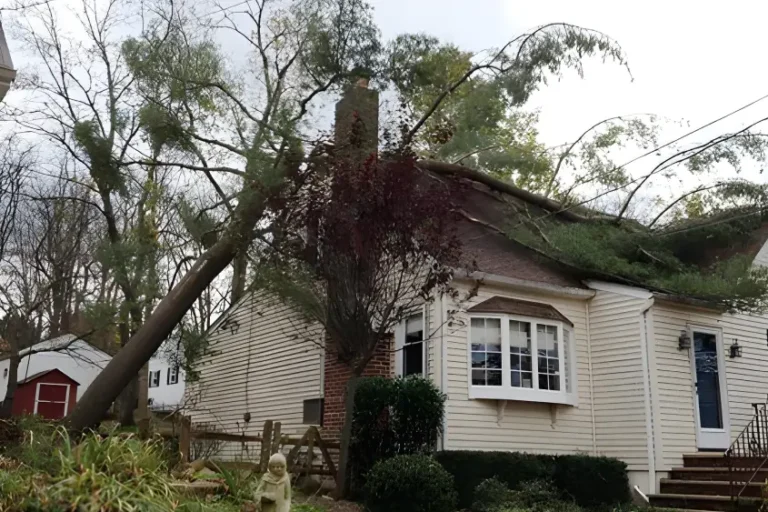
Fallen Tree on Your Property? 8 Steps to Take Now
Key Takeaways:
- Evacuate every person and pet immediately. No belongings are worth a shifting roof or leaning trunk.
- Never touch or approach a downed power line. Electricity arcs through wet ground up to 35 feet, treat every line as live.
- Document before anything moves. Missing photos can reduce or void your insurance coverage.
- Insurance covers tree removal when the tree damages a covered structure. A tree that falls in the yard with no structural contact is typically your cost to bear.
- Call a licensed, 24/7 emergency tree service before moving any large debris. A certified arborist’s written assessment protects both your safety and your claim.
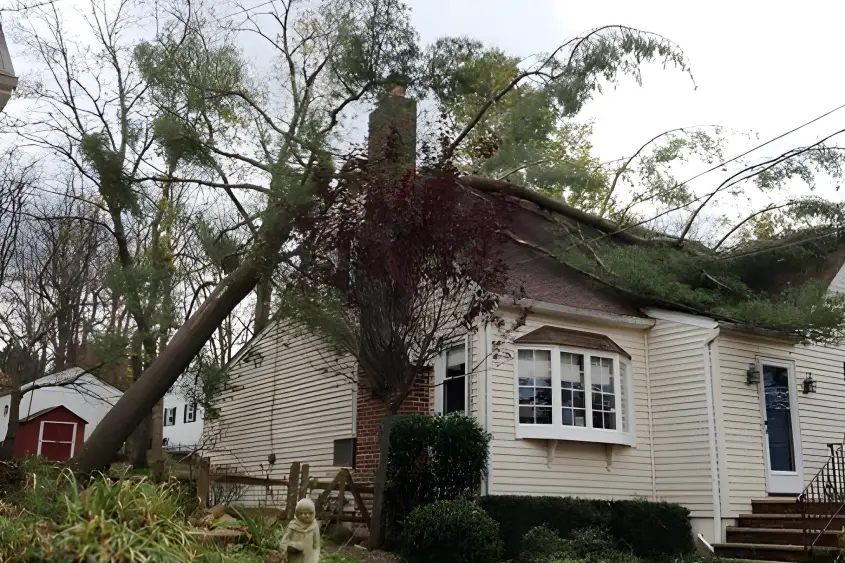
A tree crashing through your roof at 2 a.m. is one of the most disorienting moments a homeowner can face. The sound, the dust, the rain suddenly inside your house, it triggers a surge of panic that makes clear thinking almost impossible. But when a storm knocks down a tree on your property, the chaos follows a predictable pattern. And predictable problems have clear solutions. The homeowners who come through it with minimal damage, approved insurance claims, and no injuries are the ones who knew the sequence before the storm hit.
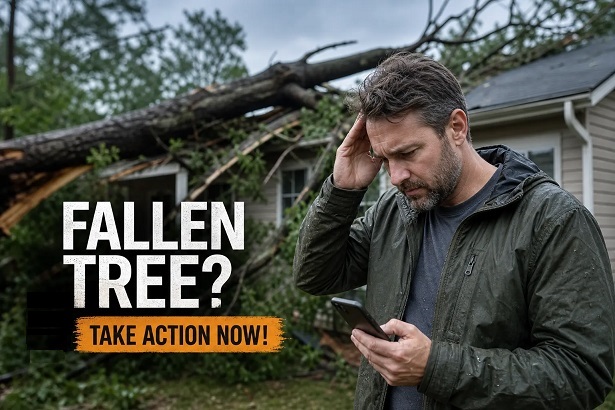
At Sage Tree Experts, we field emergency calls around the clock across New Jersey. Homeowners who had a plan, even a rough one, moved faster, made better decisions, and protected their coverage. This guide walks you through every step in order: from the second the tree hits to the day the last log clears your yard.
1. What should I do if a storm knocks down a tree on my property? Get everyone out first
Evacuate and establish a safe perimeter
Every person and every pet out of the house, immediately. That is the only priority. Move to a predetermined meeting spot at least 30 feet from the impact zone and do a headcount before you do anything else. Sagging rooflines and split trunks shift without warning. What looked stable five minutes ago can drop further.
The instinct to run back inside and grab a laptop or documents is understandable and genuinely dangerous. A leaning tree still embedded in a structure creates ongoing lateral load. The tree did not stop being a threat the moment it stopped moving.
Recognize signs the structure is no longer safe to enter
Read the house from outside before anyone considers re-entering. Visible roof deflection along the impact line, cracked exterior walls, or any audible interior sounds (creaking joists, shifting debris) mean the structure is compromised. Smoke or a burning smell from inside signals electrical contact.
Water intrusion begins immediately once the roof envelope is breached. Mold can establish within 24 to 48 hours in humid conditions, standard guidance from building science and remediation professionals. Every hour the opening stays exposed adds to secondary damage, which is why professional tarping and removal cannot wait until morning.
2. Utilities, power lines, and what never to touch
Shut off gas and electricity, if you can do it safely
If you can reach the main electrical breaker safely while still in the house, shut it off before you leave. At the gas meter outside, turn the valve perpendicular to the pipe to cut the flow, consult your utility’s guidance if you are unsure of valve orientation, or wait for the utility crew to handle it. Both steps remove significant hazards from an already unstable situation. Neither step is worth staying in a collapsing structure to complete.
When a storm knocks a tree down near power lines, treat every line as live
Electricity arcs through wet ground up to 35 feet. A “dead” line is never confirmed by appearance alone; visual inspection tells you nothing about whether current is flowing. Stay at least 35 feet back, warn neighbors and passersby, and keep children and pets clear.
Call your utility company directly in addition to 911: PSE&G at 1-800-436-7734, JCP&L at 888-544-4877, or your specific provider. NJ utility emergency lines operate 24/7, and dispatchers will prioritize any report of a line actively contacted by vegetation. Provide the town, street address, and the pole number on the metal tag if you can read it safely from a distance. Never attempt to move a tree or branch touching a power line. That job belongs to the utility crew, not the homeowner and not a tree crew, until the line is confirmed de-energized. For more on how saturated soil contributes to sudden tree failures during and after storms, see our explainer on saturated ground tree failure.
3. When 911 is the right call, and when it isn’t
Situations that require first responders immediately
Call 911 without hesitation when someone is trapped or injured, when you smell gas, when power lines are actively sparking or down, or when fire is visible. These situations require trained first responders with equipment you do not have. Every second of delay increases risk.
Outside of those four conditions, 911 is not the automatic first call when a fallen tree lands on your property. Most storm tree situations are property damage events without an active life-safety hazard. Understanding that distinction lets you move faster and get the right people on-site sooner.
When to skip 911 and go straight to an emergency tree service
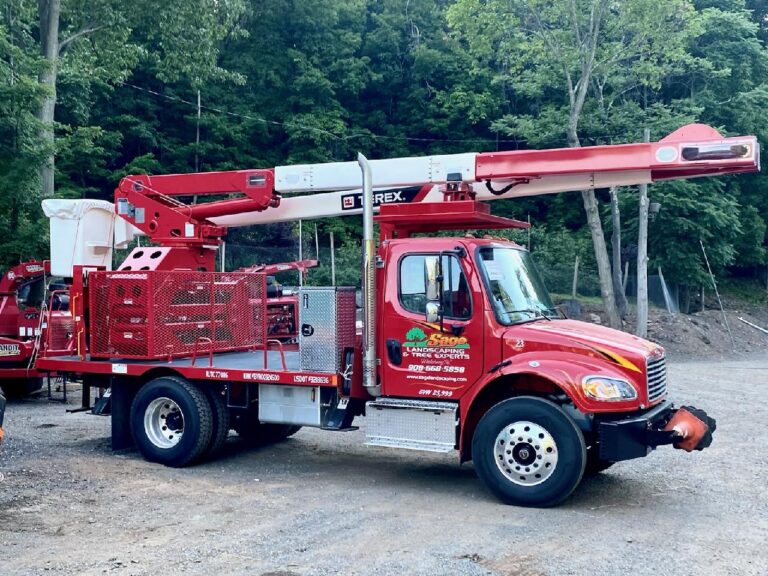
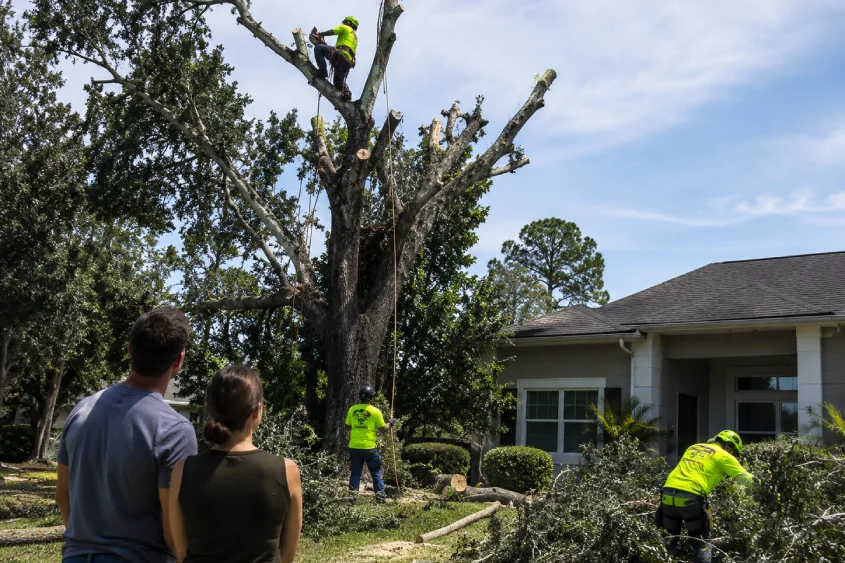
Property damage with no life-safety hazard calls for a licensed emergency arborist, not a dispatcher. A certified arborist can safely assess a tree still embedded in a structure and produce the written documentation your insurer needs to process the claim. Look for a service that offers 24/7 emergency response and has certified arborists leading every crew, those are the two details that matter most after storm-damaged tree removal.
A general handyman with a chainsaw can make the situation worse, especially when a partially embedded tree is holding a weakened roof section in place. Removing it without the right assessment and rigging can cause a secondary collapse. Waiting until morning risks additional hours of water intrusion through an open roof breach, and since mold can begin forming within 24 to 48 hours in humid conditions, time matters more than it may seem in the moment. For a closer look at how emergency crews respond and secure hazard scenes, see our piece on Storm Damage Tree Emergencies in Basking Ridge.
If a tree is down on your property tonight, Sage Tree Experts is available for emergency calls across New Jersey. Visit SageTree-Experts.com or call us for immediate emergency response from a licensed, certified crew that works directly with your insurance adjuster.
4. Document everything before a single branch moves
The photos your insurance adjuster actually needs
Start documenting the moment people are safe and utilities are addressed. Insurers require visual proof taken before cleanup begins. Take wide-angle shots of the full tree and the affected structure, close-ups of every contact point, root system photos if the tree uprooted, and separate shots showing utility line involvement if applicable. Repeat from at least four angles.
Most smartphones embed automatic date and time stamps in photo metadata, use yours. Missing photos are a common reason partial claims get denied or reduced. Cleanup cannot start until this step is complete, even if that feels frustrating in the moment.
Written records that protect your downed tree insurance claim from day one
Open your phone’s notes app and log the date, time, and weather conditions at the time of impact. Note anything relevant about the tree’s prior condition, such as visible decay, a reported lean, or recent storm damage. If this is a neighbor’s tree and you sent prior complaints in writing or had an arborist document a hazard, gather those records now. Pre-storm maintenance records proving the tree was healthy also protect you against a negligence denial.
Call your insurer within 24 hours, even on a weekend. Many insurers allow claims by phone or app around the clock. Starting the claim clock early keeps you on the right side of policy deadlines and signals that you handled the situation responsibly.
5. What your homeowner’s policy covers, and what it doesn’t
When your insurer pays for storm-damaged tree removal and repairs
The core rule is straightforward: insurance covers tree removal when the tree damages a covered structure. Home, garage, fence, deck, if the tree made contact, the removal cost is typically covered, usually capped at $500 to $1,000 per tree. If the tree falls in the yard and hits nothing, the removal cost falls on you.
NJ homeowners in hurricane-adjacent seasons should check their policy for a named storm deductible. These deductibles often calculate as a percentage of your home’s insured value, typically one to ten percent, rather than a flat dollar amount. That can be a significant number, and knowing it in advance changes your financial planning after a storm event.
Neighbor’s tree, your problem, or theirs?
New Jersey follows the negligence standard, confirmed in case law as recently as 2020 in Kornbleuth v. Westover. If a healthy tree fell during a sudden storm, the property owner where the tree landed handles cleanup through their own policy. If the tree was visibly dead, diseased, or had been formally flagged in writing, the neighbor bears liability.
Proving negligence requires showing the neighbor knew or should have known about the hazard and failed to act. Document any prior written complaints, arborist assessments, or municipal notices that predate the storm. Without that paper trail, a negligence claim is very difficult to establish regardless of how obvious the decay appeared after the fact.
6. Hiring the right removal crew before a storm chaser finds you
What to verify before anyone touches the tree
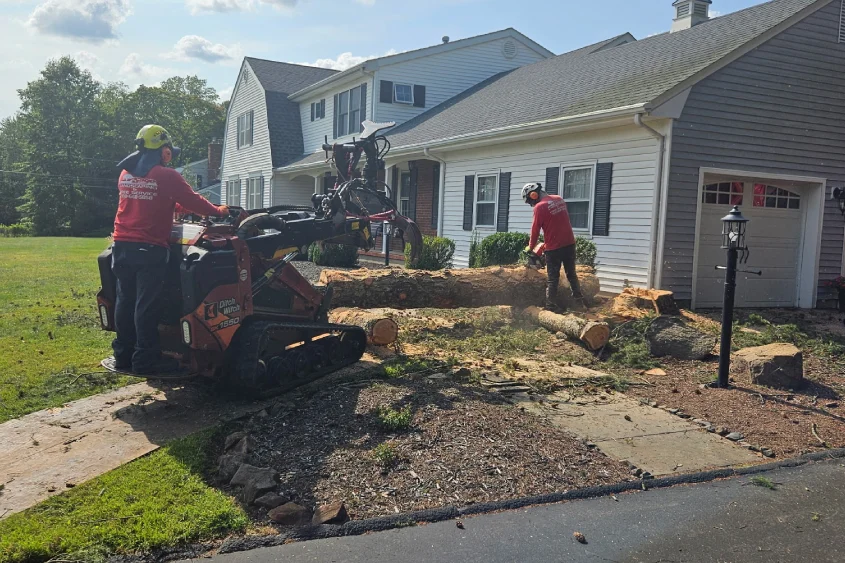
Before a crew starts work, confirm four things: an active NJ state tree care license (LTE or LTCO), general liability insurance at a minimum of $1,000,000, workers’ compensation coverage for all employees, and a written itemized estimate that separates emergency removal from standard debris cleanup. Insurers need that breakdown to allocate coverage correctly.
TCIA-certified companies meet a higher operational standard than the average crew that appears after a storm with a pickup and a chainsaw. The TCIA certification covers safety protocols, crew training, and business practices. It is one more verifiable credential that protects you when a job goes wrong and someone needs to be held accountable. For an example of emergency removal work we handle and how we document it for insurers, read about our Storm Damage Tree Removal in North Plainfield.
Red flags that signal an unlicensed storm chaser
After major NJ storms, unlicensed operators move door to door through affected neighborhoods. Watch for these specific warning signs:
- Door-to-door solicitation within hours of the storm
- Demand for large cash deposits before any work begins
- No written contract and inability to provide license numbers on request
- Pressure to sign before you get a second estimate
- No verifiable physical address or established local presence
A legitimate emergency tree service does not operate this way. Before hiring anyone for storm-damaged tree removal, ask for license numbers, proof of insurance, and a written itemized estimate. Sage Tree Experts provides all three on every job because that is what a professional operation looks like, storm or no storm.
One clear sequence protects everything that matters
A tree coming down is chaotic. Your response does not have to be. People first, utilities second, document before cleanup, call your insurer within 24 hours, and hire a licensed crew you can verify. Every homeowner who follows that sequence comes out the other side with a cleaner claim, a safer property, and no regrets about decisions made in the fog of a 2 a.m. emergency.
If you are asking what should I do if a storm knocks down a tree on my property, the answer starts with the steps above, and ends with a call to a licensed arborist who can assess the damage, document it properly, and remove the tree safely. New Jersey storms do not wait for business hours. When a storm knocks a tree down on your property and every decision feels urgent, Sage Tree Experts is one call away, licensed, certified, and ready for emergency response. Visit SageTree-Experts.com to reach our emergency line or schedule a post-storm assessment before secondary damage takes hold.
Frequently asked questions
What should I do if a storm knocks down a tree on my property and it’s embedded in my roof?
Do not attempt to remove it yourself. A partially embedded tree is one of the most dangerous situations a homeowner can face after a storm. The tree is often providing structural support to a weakened roof section; cutting it incorrectly can trigger a secondary collapse. Beyond the safety risk, most insurers require professional documentation before the tree moves. Attempting removal before that documentation exists can reduce or void your coverage for the entire incident. Call a licensed arborist first.
How long do I have to file an insurance claim after a tree falls on my house?
Most NJ homeowner’s policies require you to report a claim “promptly” or within a specific window, often 30 to 60 days, but the practical standard most adjusters follow is 24 hours. Waiting beyond that opens the door to arguments about secondary damage (water intrusion, mold, additional structural failure) that the insurer can attribute to your delay rather than the original storm event. Call your insurer or use their app the same night, even if all you can provide is an initial incident report.
What if the tree is only partially down and still leaning against my house?
A partially downed tree is often more dangerous than one that has fully fallen. The weight distribution is unpredictable, root systems may still be under tension, and any movement, wind gusts, additional rain, someone touching the trunk, can cause an uncontrolled secondary drop. Do not attempt to assess the situation from inside the house. A certified arborist needs to evaluate the loading, the structural condition of the roof, and the safest removal approach before any work begins. Treat it as an active hazard until a professional says otherwise.
Does my homeowner’s insurance cover a neighbor’s tree that fell on my property?
Your own policy covers the damage to your structure regardless of whose tree caused it, subject to your deductible. Whether the neighbor’s insurer shares that cost depends on negligence. If the tree was healthy and fell during a sudden storm, that is an act of nature and your policy handles it alone. If the tree was visibly dead or diseased, or if you had documented prior complaints about it in writing, the neighbor may bear liability under New Jersey’s negligence standard. Without written documentation of prior warnings, a negligence claim is difficult to prove.
Can I get stump removal covered by insurance after a storm?
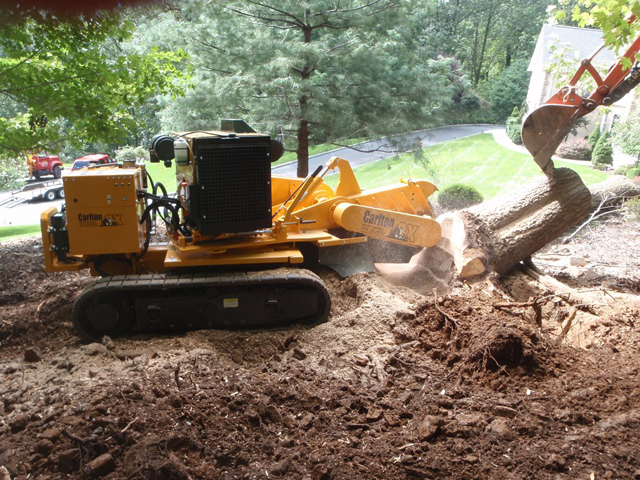
Possibly, but the coverage is limited and depends on the policy language. Most NJ homeowner’s policies include debris removal limits that cover getting the tree off the structure and clearing the immediate hazard. Stump grinding and full root removal often fall outside the covered removal cost, particularly if the stump poses no structural hazard. Request an itemized estimate from your tree service that separates emergency removal costs from stump work. Your adjuster will review each line item individually, and separating those costs gives you the clearest picture of what gets covered.